
Achieving Sub-Micron Precision: A Process Guide to Abrasives & CNC Tooling
How do you achieve 0.06 Ra on piston rods? Explore technical case studies on Centerless Grinding, Multi-Grit Wheels, and Precision CNC strategies.
Anup Kumar
11/28/20242 min read
Beyond the Machine: The Process Engineering Behind Critical Tolerances
In high-stakes manufacturing, owning a premium CNC machine is only half the battle. The real challenge lies in the Process Engineering—the specific combination of abrasive selection, cutting tool geometry, and machine kinematics required to hit sub-micron tolerances.
This guide moves beyond definitions to explore how specific tools achieve critical finishes in real-world applications, from automotive hydraulics to aerospace components.
Case Study 1: The Challenge of Automotive Hydraulics
The Component: Shock Absorber Piston Rods. The Requirement: A mirror finish of Ra 0.06 or better, with near-perfect cylindricity to prevent seal leakage.
The Solution: Centerless Grinding with Multi-Grit Technology Achieving this level of finish on a high-volume production line requires more than a standard wheel.
The Process: Centerless Grinding is chosen because it supports the workpiece along its entire length, eliminating deflection.
The Abrasive Strategy: Leading manufacturers utilize Multi-Grit (Combination Grit) Wheels.
Zone 1 (Roughing): Coarser grit removes stock quickly to establish geometry.
Zone 2 (Finishing): Finer grit polishes the surface to the required Ra 0.06—all in a single pass.
The Result: A leak-proof, low-friction surface essential for vehicle ride quality.
Case Study 2: Precision Milling in Hardened Steels
The Component: Hydraulic Valve Bodies or Injection Molds. The Requirement: Complex internal geometries with tight positional tolerance (<10μ) in hardened tool steel (50+ HRC).
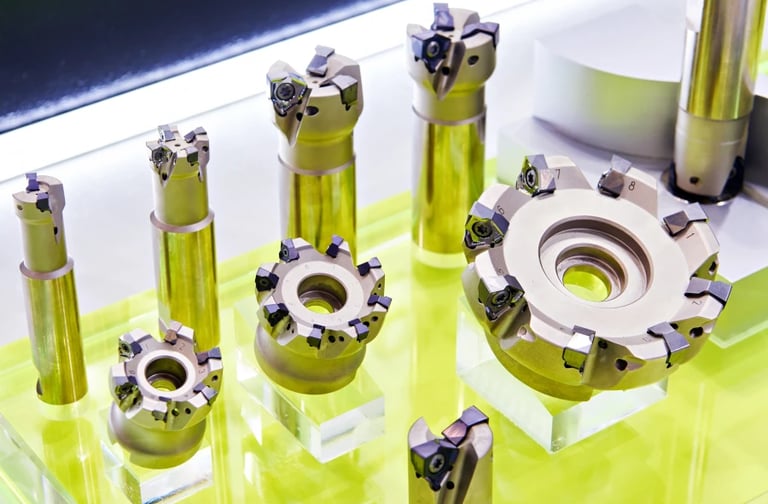
The Solution: Advanced Coating & Geometry Standard HSS tools would deflect or burn instantly. Precision here is achieved through Solid Carbide Tooling with specific enhancements:
Variable Helix Geometry: Breaking the harmonic vibration (chatter) to leave a smooth wall finish.
Nano-Coatings (TiAlN / AlTiN): These coatings insulate the tool from heat, allowing the cutter to maintain its edge integrity even during high-speed, dry machining.
The Critical Role of "Dressing" in Precision
Even the best grinding wheel fails if its surface closes up. Precision is often maintained not just by the wheel, but by the Diamond Dresser.
Rotary Diamond Dressers: For high-precision forms (like gear teeth), a rotary dresser is used to "true" the wheel continuously, ensuring that the profile grinding the part remains accurate to the micron.
Matching the Tool to the Machine
You cannot achieve 0.06 Ra if your machine spindle has runout.
Rigidity: For heavy roughing, Box Way CNCs provide the dampening needed to prevent vibration marks.
Speed: For high-finish finishing, Linear Guide machines with high-RPM spindles are required to take "dust cuts" without inducing stress.
Conclusion: Precision is a System
Achieving world-class tolerances is a symphony of variables. It requires the right Machine, the exact Process (Centerless/5-Axis), and the specific Consumable (Multi-Grit/Carbide).
Struggling to hit your required surface finish? At AVB GLOBAL EXIM™, we don't just source parts; we source processes. We vet manufacturers based on their ability to execute these specific technical workflows. Contact us to discuss your drawing requirements today.
AVB GLOBAL EXIM™ is a brand owned by AVB PRECIPRO (OPC) Private Limited.
Registered Office : 15/1739,Krishna Nivas, Chevarambalam P.O Kozhikode - 673017. Kerala. India
CIN : U46909KL2025OPC094699
GSTIN : 32ABDCA0032F1ZK
© 2025 AVB PRECIPRO (OPC) Private Limited. All Rights Reserved.