
Sub-Micron Precision: Sourcing Components with <0.1 Ra Finishes
Achieve Ra 0.06 on piston rods? AVB GLOBAL EXIM details the technical strategies we audit for—from Centerless Grinding workflows to Post-Chrome Superfinishing.
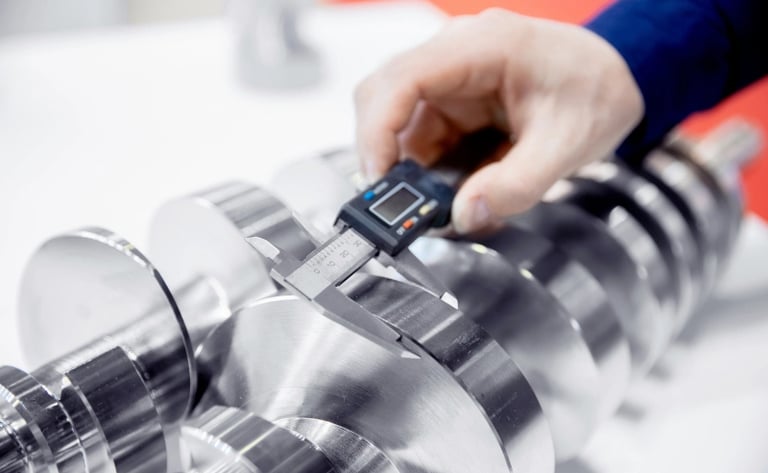
Beyond the Machine: The Process Engineering Behind Critical Tolerances
In high-stakes manufacturing, owning a premium CNC machine is only half the battle. The real challenge lies in the Process Engineering—the specific workflow of abrasive selection, heat treatment, and surface finishing required to hit sub-micron tolerances.
At AVB GLOBAL EXIM™, we don't just find suppliers; we vet their process capability. This guide explores the specific workflows we look for when sourcing critical automotive hydraulics.
Case Study 1: The "Perfect" Piston Rod (Automotive Hydraulics)
The Component: Shock Absorber Piston Rods / Inner Tubes.
The Requirement: A mirror finish of Ra 0.06 or better, with near-perfect cylindricity to prevent seal leakage.
The Workflow We Source: The "Green-to-Chrome" Cycle
Achieving Ra 0.06 isn't a single step; it is a sequence. We audit manufacturers who execute the full lifecycle:
1. Green Grinding (Pre-Plate): Before plating, the geometry must be perfect. We look for Thru-Feed Centerless Grinding using modern Ceramic (Sol-Gel) Abrasives.
Why? Ceramic grains fracture at the micro-level (self-sharpening), allowing for aggressive stock removal without generating the heat that causes sub-surface damage.
2. Hard Chrome Plating: The rod is plated to achieve wear resistance. But plating amplifies surface errors, so the pre-plate finish is critical.
3. Post-Chrome Finish (The "Final Micron"): This is where the magic happens. To hit Ra 0.06 on hardened chrome, standard grinding isn't enough. We source facilities equipped with Superfinishing / Micro-Finishing stations.
The Modern Edge: Instead of just fine-grit wheels, modern lines utilize Microfinishing Film (tape) systems. Unlike rigid stones, the film constantly indexes to present fresh abrasive, ensuring a perfectly consistent cut. This process removes plating nodules to create a high-bearing-ratio surface—ultra-smooth for the seal, yet structured enough to retain lubrication.
Case Study 2: Precision Milling in Hardened Steels
The Component: Hydraulic Valve Bodies & Injection Mold Inserts.
The Requirement: Complex internal geometries with tight positional tolerance (<10μ) in hardened tool steel (50+ HRC).
The Solution We Source: Advanced Solid Carbide Tooling
Standard tools deflect or burn in hardened steel. We source from shops that utilize specific high-performance cutters:
Variable Helix Geometry: Tools designed to break harmonic vibration (chatter), ensuring smooth wall finishes.
Nano-Coatings (AlTiN): Coatings that insulate the tool from heat, allowing the cutter to maintain edge integrity even during high-speed, dry machining.
Conclusion: Precision is a Sequence
Achieving world-class tolerances is not about one "magic" machine. It is about a disciplined sequence: Rough → Semi-Finish → Plate → Superfinish.
Struggling to find a supplier who executes this full workflow? At AVB GLOBAL EXIM™, we source processes, not just parts. Contact us today to discuss your technical requirements.
AVB GLOBAL EXIM™ is a trademark of AVB PRECIPRO (OPC) PRIVATE LIMITED.
Registered Office : 15/1739,Krishna Nivas, Chevarambalam P.O Kozhikode - 673017. Kerala. India
CIN : U46909KL2025OPC094699
GSTIN : 32ABDCA0032F1ZK
© 2025 AVB PRECIPRO (OPC) Private Limited. All Rights Reserved.